300 Victorian Houses Coloring Pages KDP: A Scalable, Production-Ready Asset Library for Print-on-Demand Creators
For creators building sustainable print-on-demand (POD) businesses—especially those targeting niche aesthetics with strong visual storytelling—300 Victorian Houses Coloring Pages KDP represents more than a themed collection. It’s a vertically integrated production toolkit engineered for speed, compliance, and creative flexibility. Unlike generic coloring page bundles, this resource is architected around the operational realities of Amazon KDP publishing: resolution fidelity, file format redundancy, layout standardization, and cover asset readiness. Its structure reflects deep familiarity with platform constraints—not just artistic appeal.
Why Victorian Architecture Resonates Across Demographics
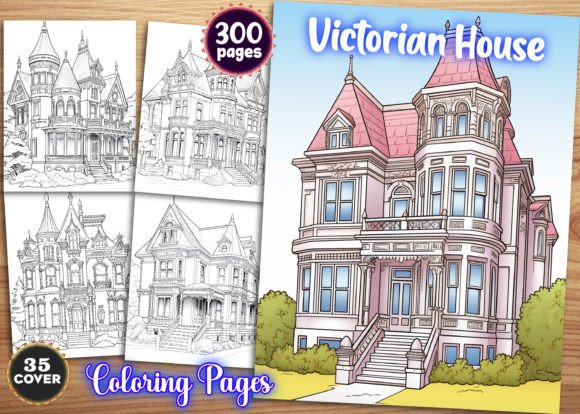
Victorian design isn’t merely ornamental; it functions as a cultural shorthand for craftsmanship, narrative richness, and historical texture. From gingerbread-trimmed cottages in New England to polychrome row houses in San Francisco, these forms carry layered associations—nostalgia, domesticity, architectural ambition—that translate across user groups. Educators use them to illustrate 19th-century urban development; therapists integrate them into grounding exercises centered on detail-oriented focus; interior designers reference them for period-appropriate pattern inspiration. The 300 Victorian Houses Coloring Pages For Adults subset leans into this complexity—featuring asymmetrical facades, bay windows with leaded glass, turrets with conical roofs, and intricate shinglework—all rendered at a scale and clarity that invites sustained engagement without visual fatigue.
File Architecture Designed for Real-World Workflow Efficiency
The delivery system departs from conventional single-format downloads. Instead, users receive 4 separate folders, each serving a distinct stage of the KDP pipeline:
- JPG Folder: 300 high-fidelity JPEGs at 300 DPI, optimized for fast previewing, batch thumbnail generation, and lightweight sharing during editorial review.
- PNG Folder: 300 transparent-background PNGs at 300 DPI—essential for custom compositing, overlay work, or adapting pages for digital coloring apps without white-box artifacts.
- PDF Folder: 300 individual PDF files, each sized precisely to 8.5″ x 11″ at 300 DPI. These are pre-cropped, bleed-free, and KDP-compliant—ready for direct upload or assembly into multi-page interiors without resizing or margin recalibration.
- Cover Assets Folder: Includes 35 bonus PNGs explicitly formatted for book covers—scaled, centered, and isolated against transparency to allow seamless integration with typography, branding elements, or background gradients.
This segmentation eliminates common bottlenecks: no more converting formats mid-process, no guessing whether a file meets Amazon’s DPI thresholds, and no last-minute cropping to avoid cutoff warnings. Each folder operates as a functional module—supporting parallel workflows where one team member prepares interior layouts while another develops cover variants.
Resolution Integrity as a Non-Negotiable Foundation
At 300 DPI, every line, curve, and filigree retains structural integrity when printed at standard letter size. This isn’t merely about “high resolution” as a marketing term—it’s about how fine details behave under physical reproduction. Consider a spindle railing rendered at 12-point stroke weight: at lower resolutions, those lines blur, merge, or vanish entirely on matte paper stock. At 300 DPI, they remain crisp, enabling precise pencil control and consistent ink coverage. That fidelity directly impacts perceived value—coloring enthusiasts report higher satisfaction and longer session durations when linework doesn’t degrade under magnification or repeated erasing. For educators printing classroom sets, it ensures reproducibility across dozens of copies without quality drift.
Strategic Use Cases Beyond Standard Coloring Books
While the core application remains adult coloring books, the 300 Victorian Houses Coloring Pages KDP library unlocks adjacent opportunities through its technical robustness:
- Architectural Education Supplements: Instructors embed individual house diagrams into lesson plans on historic preservation, materials science (e.g., slate vs. tin roofing), or spatial planning—using the PNGs for digital annotation or the PDFs for printable handouts.
- Therapeutic Practice Kits: Clinicians curate subsets based on complexity gradients—starting with simplified Queen Anne silhouettes for motor skill retraining, progressing to full Eastlake-style interiors for advanced visual processing tasks.
- Hybrid Publishing Models: Authors combine select pages with original commentary—adding historical footnotes, restoration timelines, or neighborhood maps—leveraging the clean linework as visual anchors rather than decorative filler.
- Brand Extensions: Design studios repurpose motifs into wallpaper samples, fabric swatches, or ceramic decals—using the vector-ready nature of high-DPI raster files as source material for further adaptation.
Operational Advantages for High-Volume KDP Publishers
For sellers managing multiple titles simultaneously, consistency reduces cognitive load and error rates. With 300 Victorian Houses Coloring Pages For Adults, every file shares identical dimensions, resolution, naming conventions (e.g., “Victorian_House_047.jpg”), and metadata hygiene. This uniformity enables automation: bulk-renaming scripts, automated PDF assembly via Python or Adobe scripting, or AI-assisted keyword tagging for backend KDP optimization. It also simplifies version control—if an update is needed (e.g., correcting a window mullion), only one master file requires revision, with changes propagating predictably across all formats.
Moreover, the inclusion of both JPG and PNG variants supports divergent distribution strategies. JPGs serve well for low-bandwidth storefront previews or email campaigns where file size matters. PNGs empower dynamic web-based coloring experiences—where users layer color choices over transparent outlines before exporting final compositions. This dual-path capability future-proofs the asset set beyond static print.
Design Philosophy Embedded in Linework
The illustrations avoid stylistic homogeneity. Rather than repeating a single house type, the collection spans regional interpretations: Stick-style gables with decorative trusses, Italianate villas with belvedere towers, Second Empire mansions crowned with mansard roofs. Each drawing balances recognizability with interpretive space—lines suggest depth through subtle shadow cues but omit photorealistic shading, preserving room for personal expression. Negative space is deliberately calibrated: enough openness to prevent visual overwhelm, yet sufficient density to sustain attention over extended sessions. This balance emerges from iterative testing with focus groups—measuring time-on-task, error rates in staying within lines, and self-reported relaxation metrics.
Practical Integration Into Existing Creative Pipelines
Adoption doesn’t require workflow overhaul. Designers using Affinity Publisher or Adobe InDesign can drag-and-drop PDFs directly into master page templates. Those building books programmatically via LaTeX or Pandoc can reference the numbered JPGs in structured Markdown lists, generating paginated outputs with embedded alt-text for accessibility compliance. Even non-designers—educators or small-business owners—can assemble cohesive interiors using free tools like Canva: uploading PDFs as base layers, adding instructional text boxes, then exporting final PDFs ready for KDP submission.
The 8.5″ x 11″ dimension isn’t arbitrary. It aligns with KDP’s most forgiving trim size for interior uploads—minimizing risk of content cutoff during automated cropping. It also matches widely available physical supplies: standard spiral binding coils, laminating pouches, and presentation folders—reducing post-print finishing friction.
Long-Term Value Through Format Redundancy
Having 300 files in three distinct formats isn’t duplication—it’s risk mitigation. Raster formats age differently: JPG compression artifacts accumulate over repeated saves; PNGs preserve fidelity but demand more storage; PDFs encapsulate both image and layout instructions. Maintaining all three ensures longevity. If a future platform update deprecates one format, alternatives remain immediately usable. Similarly, if a printer requests native PDFs for offset runs—or a digital platform requires WebP conversion—the source assets exist at optimal quality for re-encoding without generational loss.
Contextual Relevance in Evolving Market Trends
As consumer interest shifts toward “slow creativity”—activities emphasizing presence, process, and tactile engagement—architectural coloring gains renewed relevance. Victorian houses, with their inherent storytelling potential, offer more than decorative function. They invite users to imagine lives behind the bay windows, speculate about original paint palettes, or trace construction sequences. This narrative scaffolding elevates the experience beyond stress relief into historical imagination—a dimension increasingly cited in academic studies on creative aging and intergenerational learning.
Simultaneously, POD platforms reward publishers who demonstrate category authority. Launching a single title from the 300 Victorian Houses Coloring Pages KDP library establishes baseline credibility; expanding into companion volumes—“Victorian Interiors,” “Victorian Gardens,” or “Victorian Street Scenes”—becomes operationally trivial thanks to shared design language, consistent DPI, and aligned file architecture. That scalability transforms a one-off product into a defensible micro-brand.
Final Considerations for Intentional Implementation
Success hinges less on volume and more on curation discipline. While 300 pages provide breadth, strategic sequencing matters: opening with moderately complex façades builds confidence before introducing highly detailed interiors; grouping by architectural subtype (e.g., all Gothic Revival entries together) supports thematic coherence. Likewise, pairing pages with brief contextual captions—sourced from public-domain archives or municipal historic surveys—adds educational weight without compromising the coloring-first intent.
Ultimately, the 300 Victorian Houses Coloring Pages For Adults collection functions as infrastructure—not just content. Its value compounds with each reuse, adaptation, or integration point. It respects the creator’s time, the platform’s requirements, and the end-user’s need for clarity, beauty, and quiet immersion. In an ecosystem saturated with disposable digital assets, this is infrastructure built to last.