Renaissance Fresco Building ColoringBook
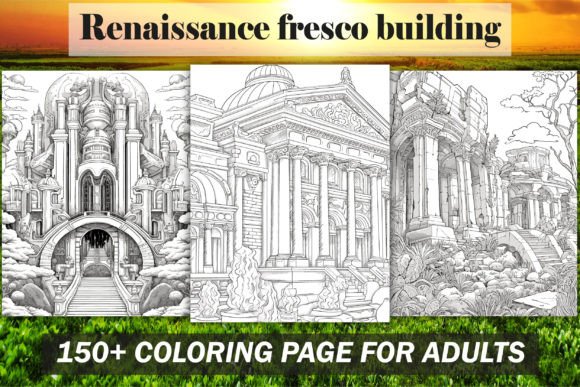
Imagine opening a coloring book and stepping into the sun-drenched piazzas of Florence, the quiet courtyards of Rome, or the grand loggias of Venice—not as a passive observer, but as an active interpreter. That’s what the Renaissance Fresco Building ColoringBook delivers: 150 meticulously crafted, printable coloring pages designed exclusively for adults, rooted in authentic Renaissance architectural language—arched windows, coffered ceilings, trompe-l’oeil niches, pilasters, balustrades, and frescoed façades—all rendered with clean linework and intentional negative space.
These aren’t generic buildings copied from stock vectors. Each design is unique—no repeats, no filler. Every page reflects deep attention to period-accurate proportion, symmetry, and decorative grammar. The result? A resource that feels both historically grounded and creatively flexible—ideal for artists who value authenticity, educators seeking tactile history tools, and KDP publishers building niche, high-intent adult coloring collections.
Why This Bundle Fits Real Creative Workflows
Unlike mass-produced clipart bundles, this set was built for *use*, not just display. All 150 JPG files are 300 PPI, 8.5″ × 11″, print-ready, and rigorously tested on Amazon KDP—no last-minute scaling, cropping, or bleed adjustments needed. That means you can upload directly to your KDP dashboard and go live within hours. No design software required. No formatting guesswork. Just consistent, professional-grade interiors ready for your next low-content launch.
But utility goes beyond technical readiness. The architectural focus opens up layered creative applications:
- Themed Skill-Building: Use individual pages as visual prompts for perspective practice, shading studies, or color theory experiments—especially valuable for art teachers creating supplemental activity worksheets.
- Niche Brand Expansion: Pair selected designs with short historical notes (e.g., “This palazzo façade draws from Bramante’s work at Santa Maria presso San Satiro”) to build companion guides or themed journals for history-minded buyers.
- Cross-Platform Repurposing: Convert select pages into social media templates (Instagram carousels showing step-by-step coloring progress), printable classroom handouts, or even SVG cut files for crafters using Cricut or Silhouette machines.
Practical Adaptation Across Audiences
Different users will find distinct value—and here’s how to make it stick:
For KDP Publishers: This bundle supports fast iteration. Launch a core 60-page version (“Renaissance Courtyards & Loggias”), then expand with sequels—“Frescoed Chapels,” “Villa Interiors,” or “Architectural Details”—all drawing from the same cohesive visual library. Consistency in line weight, scale, and composition helps build recognizable brand equity across titles.
For Educators & Homeschoolers: These aren’t just coloring sheets—they’re visual primary sources. Assign a page and ask students to identify elements like *putti*, *grotesques*, or *rustication*. Add tracing overlays for younger learners or layer annotation prompts (“Circle three examples of classical orders”) to transform passive coloring into active observation.
For Designers & Marketers: Use the clean, scalable linework as base assets for custom branding—think letterhead borders, presentation slide backgrounds, or subtle watermark patterns for digital course materials. Because all files are high-res JPGs, they integrate seamlessly into Canva, Adobe Express, or Figma without licensing friction.
Maintaining Clarity and Originality
With 150 pages, consistency matters—but so does avoiding monotony. The bundle achieves balance by varying complexity intentionally: some pages emphasize broad, open façades ideal for beginners; others layer intricate vaults, ceiling rosettes, or colonnaded arcades for advanced colorists. To keep your final product audience-friendly, consider grouping pages by difficulty level or theme in your interior layout—even if you’re using the full set.
Also, resist over-editing. These lines were drawn for clarity—not ornamentation. If you add text, use a serif font (like Garamond or Playfair Display) to echo Renaissance typography sensibilities. Leave generous margins (at least 0.5″) for binding safety and user comfort. And always test-print at least three pages before bulk uploading—KDP’s preview tool is helpful, but physical paper reveals alignment quirks digital previews miss.
Realistic Use Cases That Deliver Value
Here’s how creators are already applying this resource—without reinventing the wheel:
- A freelance educator bundled 25 pages with a 10-page PDF guide on “Architecture as History” and sold it as a downloadable resource on Etsy—positioning it for homeschool co-ops and museum education programs.
- A small publishing house used 40 pages as the interior for a 72-page softcover titled Quiet Palazzos: An Adult Coloring Journey Through Renaissance Italy, added a brief intro on Brunelleschi and Alberti, and launched it alongside targeted Pinterest ads using keywords like “Italian architecture coloring book” and “calming historical coloring.”
- A graphic designer licensed 12 high-detail pages to a stationery brand for limited-run greeting cards—featuring one building per card, with minimalist captions like “Florence, 1498” or “Verona Loggia, c. 1510.”
None required custom illustration. All leveraged the existing files—just smart framing, audience-aligned context, and clear delivery.
Final Thought: Tools Enable, But Intent Directs
The Renaissance Fresco Building ColoringBook is more than a collection of lines—it’s a focused creative catalyst. Its strength lies in specificity: it doesn’t try to be everything. It serves a defined aesthetic, a clear skill level, and real production needs. That focus makes it easier to position, market, and extend.
If you’re building a KDP catalog, start with this as your architectural anchor—then let adjacent ideas grow organically: a companion journal with reflection prompts, a printable poster pack for interior designers, or even a guided coloring video series using these pages as the base. What matters isn’t how many pages you use—but how deliberately you match each one to a real person’s need, moment, or goal.
This bundle doesn’t promise viral success. It offers something quieter, and more reliable: 150 starting points, well-made, ready to go, and waiting for your next practical, thoughtful move.