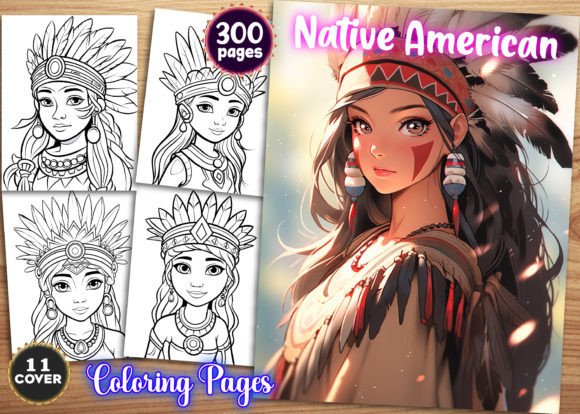
300 Native American Girls Coloring Pages
The 300 Native American Girls Coloring Pages is a digital download package designed for creators, educators, and publishers seeking culturally grounded, ready-to-use coloring content. It includes 300 original line-art illustrations—each depicting Native American girls in diverse settings, traditional and contemporary attire, and age-appropriate poses. The collection is delivered in four organized folders: JPG (300 dpi), PNG (300 dpi), PDF (300 dpi), and a bonus set of 11 PNG files intended for book cover design. All pages are sized to standard 8.5″ x 11″ dimensions, making them compatible with print-on-demand platforms like Kindle Direct Publishing (KDP).
This resource is not a general coloring book but a production-ready asset library. Its structure supports direct integration into commercial publishing workflows—especially for those building themed activity books, classroom materials, or cultural education tools. Unlike freely available clipart or generic coloring sheets, this set emphasizes intentional representation: figures reflect varied tribal affiliations, regional dress, and respectful stylization, though it does not specify individual nations or ceremonial contexts.
People may consider the 300 Native American Girls Coloring Pages for several practical reasons. Educators might use it to supplement social studies units on Indigenous peoples of North America, supporting visual literacy and inclusive curriculum development. Independent authors and KDP publishers often seek high-resolution, copyright-cleared assets to accelerate book creation—particularly for niche markets like culturally responsive children’s resources. Therapists and counselors sometimes incorporate culturally affirming imagery in expressive art activities, especially when working with Native youth or families seeking identity-positive materials.
One benefit is production efficiency. With 300 images across three widely supported formats—and no licensing restrictions for commercial reuse—the package reduces time spent sourcing, editing, or resizing artwork. The inclusion of both JPG and PNG files allows flexibility: JPGs suit print layouts where background transparency isn’t needed; PNGs preserve transparent backgrounds, useful for layered designs or digital adaptations. The PDF folder offers print-ready single-page files, ideal for immediate classroom handouts or proofing before bulk printing.
However, users should weigh certain considerations. While the collection prioritizes respectful depiction, it does not include educational notes, tribal attributions, or historical context with each image. Users intending to use these pages in formal educational or cultural programming should complement them with accurate, community-vetted resources—such as materials developed by tribal education departments or organizations like the National Museum of the American Indian. Relying solely on the coloring pages without supplementary context risks oversimplification or misrepresentation.
Another tradeoff involves artistic style consistency. The 300 illustrations follow a unified clean-line aesthetic suitable for children ages 4–10, but they are not drawn by a single artist. Subtle variations in proportion, line weight, and detail level exist across the set—a normal outcome in large-scale commissioned illustration projects. For publishers aiming for absolute stylistic uniformity (e.g., for a branded series), minor post-production editing may be necessary.
The package is a strong fit for users whose primary goal is rapid, compliant content deployment. If you’re preparing a KDP upload and need exactly 300 interior coloring pages—formatted correctly, resolution-verified, and legally cleared for resale—the 300 Native American Girls Coloring Pages meets that functional requirement directly. It also suits users who already have subject-matter expertise or access to vetted cultural consultants and want scalable visuals to pair with their own text, lesson plans, or therapeutic frameworks.
Conversely, alternatives may be preferable in other situations. For example, if your project requires deep cultural specificity—such as depictions tied explicitly to Diné (Navajo) weaving motifs, Haudenosaunee regalia, or Tlingit formline art—this collection, while broadly representative, does not provide that level of tribal granularity. In such cases, commissioning custom illustrations from Native artists or licensing from tribally affiliated archives would better serve authenticity goals.
Similarly, if you need adaptable digital tools—like editable vector files (SVG or AI), animated versions, or interactive PDF features—this package does not supply those. Its JPG, PNG, and PDF outputs are raster-based and static. Users planning digital learning applications (e.g., tablet-based coloring apps or web-based activities) may need to convert or augment the files using graphic software, which adds technical overhead.
Accessibility is another factor. The line art is clear and well-spaced, appropriate for early-elementary fine motor development. However, the set does not include differentiated versions—for instance, simplified outlines for younger children or advanced detail layers for older students. Educators serving mixed-age groups may need to curate subsets or modify files accordingly.
When evaluating whether this resource aligns with your needs, begin by clarifying your end use. Ask: Is the goal to publish a commercially viable coloring book on KDP? Then the format, count, and resolution match common platform requirements. Are you developing classroom lessons? Then assess whether the imagery complements existing standards-aligned content—and whether you can integrate supporting narratives about sovereignty, language revitalization, or contemporary Native life. Are you creating therapeutic tools? Consider whether the figures resonate with the identities and experiences of the children you serve—and whether additional guidance (e.g., discussion prompts or reflection questions) will accompany the pages.
Also review file management expectations. The download contains 900+ individual image files (300 each in JPG, PNG, and PDF, plus 11 covers). Organized folder structure helps, but users unfamiliar with digital asset organization may benefit from renaming conventions or batch-processing tools to streamline uploads or layout work.
Finally, consider sustainability beyond the download. While the package enables efficient creation, long-term value depends on how thoughtfully the images are contextualized. A coloring page of a girl wearing ribbon skirt becomes more meaningful when paired with information about its significance in Anishinaabe and other Great Lakes communities—or when connected to living traditions like powwow dancing or Two-Spirit visibility. The 300 Native American Girls Coloring Pages provides the visual foundation; responsible use means building upon it with accuracy, respect, and collaboration where possible.
In summary, this collection serves a specific, practical function: delivering a large volume of culturally conscious, production-ready coloring art. Its strength lies in scalability and compatibility—not in exhaustive cultural annotation or bespoke customization. Readers deciding whether to use it should anchor their choice in concrete objectives: timeline, platform requirements, audience needs, and capacity to add meaningful context. When matched to the right use case, it functions effectively as one component within a broader, ethically informed creative or educational process.