Axolotl Coloring Pages for Kids
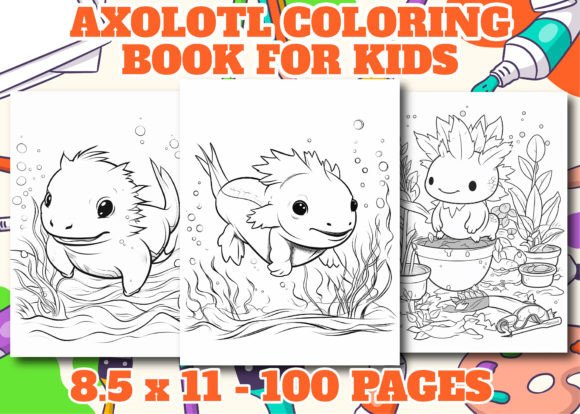
For creators building scalable, low-overhead digital product businesses on Amazon KDP—or expanding their print-on-demand (POD) catalog—Axolotl Coloring Pages for Kids isn’t just another themed download. It’s a strategically designed, production-ready asset bundle built for real-world execution. Unlike generic clipart packs or hastily assembled PDFs, this collection delivers 50 original, high-resolution illustrations optimized for commercial use: 50 JPGs, 50 PNGs, and 50 editable AI files—all at 300 DPI, A4 and US letter size (8.5” × 11”). You also receive one professionally crafted cover image and a clean, organized .zip file containing all assets in PDF, JPG, PNG, and AI formats.
Why This Bundle Fits Real Business Needs—Not Just Trends
Most coloring page bundles fail at the intersection of quality, usability, and market alignment. They’re either under-designed (low resolution, inconsistent line weight), over-saturated (featuring tired themes like unicorns or rainbows), or technically impractical (no vector files, no transparent backgrounds). Axolotl Coloring Pages for Kids avoids those pitfalls by centering on a rising niche: biologically intriguing, education-adjacent subjects with strong visual appeal. Axolotls—neotenic salamanders known for regeneration and wide-eyed charm—resonate across audiences: homeschoolers seeking science-linked activities, therapists using art for emotional regulation, and parents drawn to calming, non-violent imagery.
This isn’t about chasing viral novelty. It’s about selecting a theme with durable demand: axolotls have seen steady search growth on Amazon and Pinterest over the past three years, with minimal direct competition in *premium-tier* KDP interiors. That means less price pressure, higher perceived value, and room to position your book as “educational yet playful”—a positioning that supports premium pricing and cross-promotion (e.g., pairing with STEM activity guides or classroom resources).
Strategic Use Cases Beyond the Obvious
You can publish a standalone coloring book—but that’s only the baseline. The real leverage lies in how you extend and repurpose the assets:
- Multi-format publishing: Use the AI files to create variations—add subtle watercolor textures for a “deluxe edition,” convert outlines to grayscale for high-contrast accessibility versions, or isolate individual axolotls to build themed mini-books (e.g., “Axolotls Underwater,” “Axolotls in Space”).
- Brand-aligned expansion: If you run an eco-education brand, embed these pages into a larger “Ocean Life Activity Kit” PDF bundle. The PNGs with transparent backgrounds integrate cleanly into Canva templates, Notion planners, or printable lesson plans.
- Operational efficiency: Because every file is 300 DPI and properly sized, you avoid costly prepress corrections. No resizing artifacts. No bleed-line guesswork. Upload directly to KDP or your POD platform—and get it live in under 90 minutes.
- Educational credibility: Include a one-page species fact sheet (written by you or sourced from public-domain NOAA/National Geographic material) as the intro. That small addition transforms a coloring book into a light learning tool—increasing dwell time, review depth, and perceived authority.
What to Consider Before You Publish
High-resolution files don’t guarantee success—intentional positioning does. Before uploading, ask yourself:
- Who specifically benefits—not just “kids,” but which kids? Age range matters: simple outlines suit ages 4–7; detailed backgrounds with botanical or aquatic elements engage 8–12 year olds. This bundle includes both styles—use that range deliberately. Don’t mix complexity levels randomly across pages.
- How does this fit your existing catalog—or fill a gap? If your store already sells dinosaur or space-themed books, adding axolotls extends your “science curiosity” vertical without diluting focus. But if your brand centers on mindfulness for adults, this may misalign unless reframed (e.g., “Regeneration & Resilience: An Axolotl-Themed Journal for Grown-Ups”).
- Are you optimizing for discoverability—or just completion? KDP’s algorithm rewards relevance. Use precise, search-informed keywords: “axolotl coloring book for kids,” “neotenic salamander activity pages,” “STEM coloring pages for elementary.” Avoid vague terms like “cute animal coloring”—they attract price-sensitive buyers and increase ad spend inefficiency.
Risks of Using Without Context
Even excellent assets become liabilities when deployed without strategy. Common missteps include:
- Publishing without testing cover appeal: Your included cover image is professional—but it may not outperform custom A/B tests. Run two variants on Kindle Direct Publishing’s previewer: one with the provided cover, one with bold typography and a single centered axolotl. Let click-through data—not assumptions—guide your final choice.
- Ignoring interior consistency: While the 50 designs are cohesive, randomly ordering them creates visual fatigue. Group by complexity: start simple (pages 1–10), build detail (11–35), end with immersive scenes (36–50). That arc supports sustained engagement—a factor reviewers notice and mention.
- Overlooking regional sizing expectations: Though files are A4 and US letter ready, KDP defaults to US letter. If targeting EU buyers, confirm your paperback trim size matches A4 (210 × 297 mm) and adjust margins accordingly. A mismatched bleed causes cropped artwork—a trust-breaker.
Design Flexibility That Scales With Your Goals
The inclusion of AI (Adobe Illustrator) files changes what’s possible—not just for you, but for collaborators. Need a version formatted for Teachers Pay Teachers? Extract layers, recolor backgrounds, add dotted lines for tracing. Want to license select pages to a children’s app developer? Deliver clean vector exports with embedded metadata and usage terms. Even if you don’t own Illustrator, free tools like Inkscape open AI files reliably—giving you full control over stroke width, layer visibility, and export presets.
And because all JPG and PNG files are 300 DPI and precisely 8.5” × 11”, resizing is safe—within reason. Enlarge up to 120% for poster-sized prints; shrink to 75% for pocket-size activity cards. Just avoid repeated scaling cycles: always edit from the original AI or PNG source, not a resized JPG.
Long-Term Value Beyond the First Book
This bundle pays dividends beyond its initial publication. Archive the AI files as your “axolotl master library.” Next year, when you launch a companion journal or sticker pack, pull from the same visual language—ensuring brand continuity. License unused variants to educational nonprofits (with clear attribution terms) to build backlinks and domain authority. Or repurpose outlines as SVGs for Cricut/Silhouette users—expanding into craft markets with near-zero additional design cost.
More importantly, it trains your decision-making muscle: choosing assets not for quantity, but for adaptability, technical readiness, and audience alignment. That discipline compounds. Every subsequent product—whether a puzzle book, flashcard set, or bilingual activity guide—benefits from the same criteria: Is it production-ready? Does it serve a specific need? Can it evolve with my goals?
Axolotl Coloring Pages for Kids works because it respects your time, your standards, and your strategy. It doesn’t ask you to hope. It gives you calibrated tools—and invites you to use them with intention.