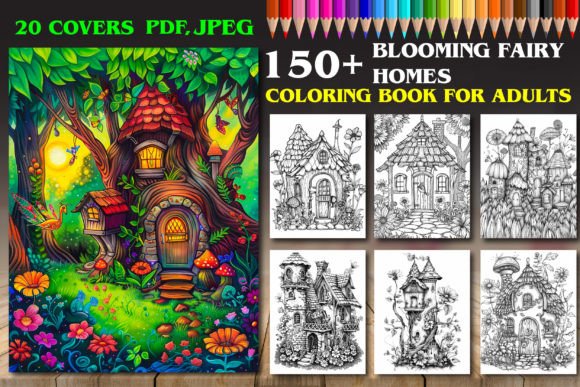
Blooming Fairy Homes Coloring Pages
Imagine opening a door into a sun-dappled glade where mushrooms double as porches, flower petals form canopied roofs, and ivy-wrapped cottages nestle beneath ancient oak roots. That’s the world waiting in the Blooming Fairy Homes Coloring Pages — a thoughtfully crafted digital collection designed not just for coloring, but for mindful presence. With over 150 original black-and-white illustrations, this resource offers more than visual charm: it delivers therapeutic structure, creative flexibility, and professional-grade usability — especially if you know how to use it well.
What It Is — And Why It Resonates Beyond “Just Another Coloring Book”
This isn’t a mass-produced compilation scraped from generic clipart libraries. Each illustration in the Blooming Fairy Homes Coloring Pages is hand-drawn with intentional line weight, balanced negative space, and layered botanical detail — think climbing wisteria, foxgloves with delicate veining, and fairy doors carved into tree trunks with visible wood grain. The A4 (8.5×11 inch) size and 300 DPI resolution ensure crisp prints whether you’re using a home inkjet or sending files to a print-on-demand service like KDP.
For adults seeking restorative focus — not distraction — these pages support deep flow states. Unlike overly dense mandalas that overwhelm beginners, or sparse outlines that feel underwhelming to experienced colorists, this set strikes a consistent middle ground: intricate enough to engage attention, open enough to invite personal interpretation.
A Common Mistake: Assuming All “High-DPI” Files Are Print-Ready
Many buyers assume “300 DPI” automatically means “ready for KDP.” Not quite. Some sellers label JPEGs as “print-ready” even when they’re exported at 72 DPI and upscaled — which leads to blurry edges, pixelation around fine lines, and rejected KDP uploads. In the Blooming Fairy Homes Coloring Pages, every JPEG and PDF is natively rendered at true 300 DPI, tested across multiple printers and KDP preview tools. But here’s what still trips people up: forgetting to embed fonts or flatten layers when editing covers. The included 20 PNG cover files are transparent-background, layer-free, and fully scalable — no hidden rasterization traps.
Overlooking File Structure — And Paying for It Later
One overlooked detail? How the files are organized. Some coloring page bundles dump 150+ images into one folder with auto-generated names like “IMG_001.jpg” — making it impossible to find “mushroom cottage with dragonfly” without opening dozens of thumbnails. The Blooming Fairy Homes Coloring Pages uses descriptive, consistent naming (“fairy-home-moss-door-spring-bloom.jpg”) and groups related themes (e.g., “Tree Hollow Homes,” “Flower Pot Dwellings,” “Mushroom Village”) — saving hours when curating a themed KDP interior or building a branded social media series.
Example: A freelance educator building a mindfulness workshop once selected a cheaper bundle with unsorted files. She spent two full afternoons renaming and categorizing — time she could’ve used designing guided reflection prompts. With Blooming Fairy Homes, that prep work is already done.
Misjudging Scale Compatibility Across Devices
Another quiet pitfall? Assuming a file labeled “A4” will render identically on every screen or printer. Without proper bleed margins or crop marks, borders may get cut off — especially on KDP’s strict interior specs. The Blooming Fairy Homes Coloring Pages includes both centered single-page JPEGs *and* a ready-to-upload PDF with built-in 0.125-inch bleed and CMYK-safe line art — meaning no last-minute resizing or reformatting before publishing.
Why “Intricate” Doesn’t Mean “Inaccessible”
Some adult coloring collections lean so heavily into complexity that beginners feel discouraged after five minutes. Others sacrifice detail to chase broad appeal — ending up bland. The strength of Blooming Fairy Homes Coloring Pages lies in its graduated intricacy: early pages feature clear architectural outlines and generous spacing between elements; later ones introduce overlapping foliage, textured stone walls, and subtle shadow cues — all while maintaining readability at standard print sizes.
This matters most for educators, therapists, and content creators who need tiered material. One occupational therapist told us she uses the first 30 pages for clients developing fine motor control, then shifts to mid-range designs for attention-building exercises — all without switching resources.
What to Check Before You Download or Publish
- Preview actual samples — Not just thumbnails. Zoom in on a flower petal or window frame. Do lines stay sharp? Is there unintended dithering or anti-aliasing blur?
- Verify file types match your workflow — Need editable vector files? This set is raster-only (JPEG/PNG/PDF), optimized for coloring — not logo design. That’s intentional, not a limitation.
- Confirm licensing scope — These pages include commercial use rights for physical and digital resale (including KDP), but not for creating competing coloring page bundles. Always read the license summary — not just the headline.
- Test one page on your printer first — Especially if using matte or textured paper. Line clarity can vary significantly by paper weight and ink type.
Realistic Use Cases — Beyond the Obvious
Yes, it’s perfect for relaxation and self-care — but its versatility extends further. Bloggers use individual pages as Pinterest-optimized lead magnets (e.g., “Free Fairy Garden Coloring Page + Planting Tips”). Small business owners print select designs on eco-friendly cards for seasonal promotions. Educators embed them into nature-study units on pollination or mycology — turning “color the mushroom” into a conversation about spore dispersal. Even marketers repurpose clean line art for minimalist social posts, overlaying gentle copy about slow living or creative resilience.
The key is treating the Blooming Fairy Homes Coloring Pages not as static art, but as adaptable creative infrastructure — designed with intention, tested for real-world use, and built to scale with your goals.