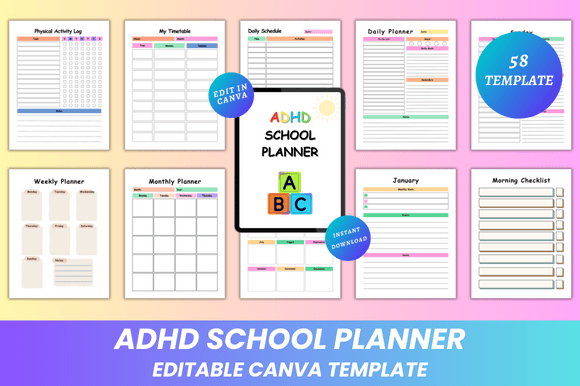
Editable ADHD School Planner Canva KDP: A Flexible, Neuro-Inclusive Planning Tool for Students and Educators
For students navigating the academic world with ADHD—or for educators, parents, and support professionals seeking adaptable, low-pressure planning resources—the Editable ADHD School Planner Canva KDP offers something rare: structure without rigidity. Unlike static printables or rigid digital apps, this planner is built on Canva’s intuitive platform—meaning every element is fully customizable before printing or digital use. It’s not just a planner; it’s a responsive learning companion designed around executive function needs.
What Makes This Planner Truly Editable—and Why That Matters
The phrase “Editable ADHD School Planner Canva KDP” isn’t marketing fluff—it reflects a foundational design choice. Every page in the Editable ADHD School Planner Canva KDP Interior is crafted as a Canva template. That means you can adjust fonts to reduce visual clutter, increase text size for readability, swap colors to match sensory preferences, reposition sections to prioritize what matters most each day, or even insert photos of routines, rewards, or calming visuals. No coding. No software downloads. Just drag, type, and personalize.
This level of control supports real-world ADHD challenges: shifting focus, time blindness, task initiation difficulty, and emotional regulation. When a student can highlight their Morning Checklist in yellow and mute distracting borders in their Daily Schedule, they’re not just “using a planner”—they’re co-designing a tool that meets them where they are.
A Feature Set Built for Real Academic Life
The Editable ADHD School Planner Canva KDP includes over 30 thoughtfully organized components—each editable, each purpose-driven. Here’s how key features translate into daily support:
- Daily & Weekly Structure: Monday–Sunday, Daily Planner, and Weekly Planner pages help break down overwhelming timelines into manageable, visual chunks—ideal for students who lose track between classes or deadlines.
- Academic Accountability Tools: The Assignment Tracker, Homework Tracker, Grade Tracker, and Lesson Plan sections empower students to monitor progress—not just completion—while giving teachers or tutors quick insight into patterns (e.g., consistent delays on long-form assignments).
- Executive Function Scaffolds: My Timetable, Study Task List, and Goal Tracker provide external memory support—critical when working memory is overloaded. Paired with ADHD Notes and Important Notes, they normalize reflection and self-advocacy.
- Wellbeing Integration: Rather than treating academics and wellness as separate, the planner weaves them together: Daily Mood Tracker, Physical Activity Log, Cleaning Task List, and Favorite Quotes reinforce holistic self-care as part of learning—not an afterthought.
- Reading & Curiosity Support: Sections like Books I Want To Read, Book Review, and Library Tracker gently encourage engagement with literacy outside grading pressure—valuable for students whose attention thrives in narrative or visual formats.
No One-Size-Fits-All: Who Benefits Most?
While created with ADHD learners in mind, the Editable ADHD School Planner Canva KDP serves a broader ecosystem:
- Students ages 10–25 who need flexibility across subjects, schedules, and energy levels;
- Special educators and school counselors who adapt materials for IEPs or 504 plans—and appreciate having editable source files to modify for individual goals;
- Homeschooling families seeking consistency without inflexibility—especially those blending unschooling principles with structured skill-building;
- Therapists and ADHD coaches who assign planning as part of metacognitive training—and want clients to own the process visually and emotionally;
- College undergraduates managing hybrid courses, part-time work, and independent study—where autonomy and customization aren’t luxuries, but necessities.
Practical Use: From Canva to Classroom (or Kitchen Table)
Here’s how it works in practice:
- You receive an Editable Canva Link—no account required to view, but a free Canva account unlocks full editing.
- Open any page: tweak color palettes to reduce visual fatigue, enlarge checkboxes for motor coordination, or add icons beside “Science Lab” or “Lunch” for faster scanning.
- Once customized, download high-resolution files: print-ready 8.5 x 11 inches PDFs (optimized for home printers or local print shops), plus JPG and PNG versions for digital annotation or tablet use.
- Bind pages into a physical notebook—or load them into Notability, GoodNotes, or OneNote for stylus-friendly interaction.
Real example: A 7th grader with slow processing speed uses the Evening Checklist to sequence “pack backpack → review tomorrow’s schedule → choose outfit” with custom emoji cues. Her mom edits the School To Do List weekly—removing completed items, adding teacher reminders, and adjusting font weight so priorities stand out. No re-purchasing. No waiting for updates. Just ongoing, responsive support.
Strengths—and Honest Considerations
Strengths:
- Neurodiversity-aligned by design: Prioritizes clarity, choice, and low-stimulus layouts over decorative overload.
- Ownership-focused: Editing fosters agency—a key predictor of long-term self-management skills.
- Multi-format utility: Works equally well printed, digitally annotated, or projected during parent-teacher conferences.
- Scalable scope: From Yearly Planner (Jan–Dec) to Belongs To page (for labeling binders or tablets), it grows with the user’s needs.
Considerations:
- Requires basic familiarity with Canva—but no design expertise. Tutorials are freely available, and many users master core edits in under 10 minutes.
- Not an automated app: it won’t send reminders or sync across devices. Its power lies in intentionality—not automation.
- Best used alongside coaching or modeling: especially for younger users, initial guidance helps transform “editable” into “meaningfully adapted.”
Evaluating Fit: Is This Right for You—or Your Student?
Ask these questions:
- Do rigid templates cause avoidance or frustration?
- Is visual customization—like changing colors or spacing—consistently helpful for focus or calm?
- Are printable or tablet-friendly tools preferred over subscription-based apps?
- Is there value in having one cohesive system that covers academics, wellbeing, reading, and goals—without juggling five different platforms?
If you answered “yes” to two or more, the Editable ADHD School Planner Canva KDP is likely a strong match. It doesn’t promise perfection—it promises partnership. A chance to build routine *with* neurodivergent thinking, not against it.
Final Thought: Planning as Practice, Not Perfection
ADHD isn’t a deficit of effort—it’s a difference in how attention, time, and motivation interface with environment. The Editable ADHD School Planner Canva KDP Interior acknowledges that truth. It doesn’t ask students to “try harder” to fit outdated systems. Instead, it hands them the pen—and the palette—to draft their own path forward. Whether used to track library due dates, celebrate small wins in the Mood Tracker, or simply claim space for a Thank You note at day’s end, it affirms one essential idea: How you plan matters as much as what you plan.