Goldfish Coloring Pages for Kids
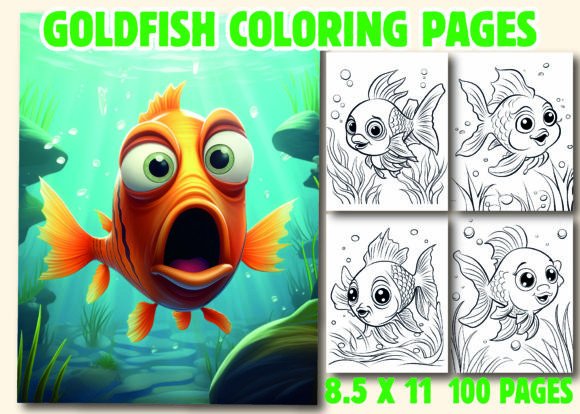
If you're building a high-content coloring book for Amazon KDP—and actually want it to sell—you need more than just cute fish outlines. You need pages that hold attention, print cleanly at 8.5″ x 11″, scale without pixelation, and give buyers real value the moment they open the PDF. That’s exactly what this Goldfish Coloring Pages for Kids interior delivers: 100 unique, hand-crafted (but AI-assisted for precision) line art pages—each one distinct in pose, expression, habitat, and detail level.
Think about how people really use coloring books—not as abstract “creative tools,” but as practical resources. A homeschool parent needs something printable *today* for a rainy afternoon lesson on marine life. A small business owner running a kids’ craft studio needs clean, scalable PNGs to project onto a whiteboard or resize for party favor tags. A freelance designer building a themed activity bundle for Etsy or Teachers Pay Teachers needs editable AI source files—not locked-down JPEGs—to tweak line weight or add custom borders. This collection was built with those moments in mind.
Where It Fits Into Real Workflows
Let’s get specific. If you’re uploading to KDP, you know Amazon rejects interiors with blurry lines, inconsistent margins, or mismatched DPI. These pages are pre-optimized: 300 DPI, CMYK-ready, centered with 0.25″ bleed-safe margins, and tested across multiple KDP previewers—including the mobile app. No last-minute panic over “low-resolution image” warnings.
But beyond technical readiness, it’s about flexibility. The included AI source file (in vector-friendly format) means you can isolate fins, adjust eye size for younger kids, or batch-add water bubbles using your own design system. Not every creator uses Illustrator—but if you do, that file saves hours. Even if you don’t, the 100 JPG and 100 PNG versions cover nearly every digital need: social media posts (PNG for transparency), blog printables (JPG for fast loading), or layered Canva templates (PNG + background removal).
Who Uses This—and Why It Sticks
A kindergarten teacher in Ohio printed six copies of page #47—“Goldfish Swimming Through Seaweed”—for her ocean unit. She laminated them, added dry-erase markers, and rotated them through learning stations. Why that page? Because the seaweed curves guide fine motor control, the fish’s open mouth invites storytelling (“What is it saying?”), and the spacing leaves room for dictated sentences underneath. That’s not luck—that’s intentional design baked into each of the 100 pages.
Meanwhile, a part-time illustrator in Portland used three pages as base layers for a client’s boutique aquarium shop branding—adding subtle gradients, converting outlines to duotone, and exporting as SVG for signage. She didn’t redraw from scratch; she leveraged clean, consistent linework that held up under stylization. That’s the quiet power of having 100 options: no forced repetition, no awkward scaling, no copyright risk from traced clipart.
And for the solopreneur launching their first KDP coloring book? This interior removes guesswork. You get a full 100-page spine-ready layout—not 30 pages padded with repeats or borders. You pair it with your own cover (included in high-res PNG and JPG), upload the PDF, and list. No testing fonts, no wrestling with bleed zones, no second-guessing whether “page 63 looks too sparse.” It’s done. Tested. Live on KDP.
What to Consider Before You Use It
This isn’t a generic clipart pack. It’s purpose-built for one platform—Amazon KDP—and optimized for one outcome: sales velocity. That means some trade-offs. There are no watercolor textures, no grayscale shading, no cartoon speech bubbles. Why? Because KDP’s black-and-white interior option (the most common and profitable for kids’ coloring books) requires crisp, unbroken lines—and anything extra adds noise, not appeal. If you need painterly effects, this isn’t your set. But if you need reliable, kid-tested, printer-ready line art that converts browsers into buyers? It is.
Also consider your audience’s age range. These pages vary in complexity: pages #1–#25 lean simpler (larger shapes, fewer internal details)—ideal for ages 3–6. Pages #26–#75 introduce gentle challenges: overlapping plants, subtle scales, flowing tails. Pages #76–#100 include light scene-building (bubbles, coral arches, treasure chests) for ages 7–10. You won’t need to curate or sort—just know where to position each tier if you’re marketing by age group.
And yes—this is only for Amazon KDP. The license restricts use on other platforms like Etsy, Redbubble, or your own Shopify store. That’s intentional. It keeps the market focused, avoids oversaturation, and protects your investment. If you’re building a broader digital product suite, treat this as your KDP anchor—then create complementary assets (like animated goldfish GIFs or printable reward charts) elsewhere.
How It Moves Beyond “Just Another Coloring Book”
Look at what happens when you combine usability with intentionality. A speech therapist in Texas uses page #89—“Goldfish Blowing Bubbles”—to practice /b/ and /p/ sounds. She asks kids to name each bubble shape (“circle,” “oval,” “heart”) while coloring. A Montessori tutor uses page #12—“Goldfish Looking Up”—to discuss perspective and directionality (“Is the fish looking *up* or *down*? What’s above it?”). A camp counselor prints pages back-to-back, staples them into mini-books, and hands them out during car rides—no prep, no ink waste, no screen time.
That’s the difference between a decorative download and a working tool. Every goldfish here has clear eyes (not shaded blobs), defined gills (not smudged lines), and balanced negative space (so crayons don’t bleed outside the lines). These aren’t afterthoughts—they’re decisions made after watching how real kids hold pencils, how home printers handle thin lines, and how Amazon’s algorithm ranks “goldfish coloring book for toddlers” versus “goldfish coloring pages for kids.”
You don’t need to be a designer to use this. You don’t need a team. You need a clear goal—launch a high-quality, low-friction KDP coloring book—and the right interior to match it. That’s what Goldfish Coloring Pages for Kids solves. Not theoretically. Not someday. Right now—with your next upload.