Jellyfish Coloring Pages for Kids
Coloring isn’t just play—it’s a quiet engine for focus, fine motor development, and creative confidence in children. When you choose Jellyfish Coloring Pages for Kids, you’re selecting more than whimsical sea life outlines—you’re investing in a tool that supports calm engagement, visual literacy, and joyful repetition. These pages resonate especially well with young learners drawn to ocean themes, sensory-friendly line work, and gentle complexity—neither overwhelming nor underwhelming. But not all jellyfish-themed coloring collections deliver the same value, especially when scaled for professional use on Amazon KDP.
Why “Good Enough” Files Often Fall Short on KDP
Many creators assume that any printable jellyfish coloring page will translate smoothly into a high-content KDP book. That’s where assumptions quietly derail results. A common misstep is downloading low-resolution PNGs or JPEGs from free sites and resizing them to fit an 8.5″ x 11″ interior. The outcome? Blurry lines, pixelated tentacles, and thin strokes that vanish during printing—especially on standard KDP paper stock. Readers notice. Reviews mention “faint outlines” or “hard to color.” Those aren’t subjective complaints—they’re technical warnings about resolution mismatch.
Another overlooked detail: inconsistent line weight. Some jellyfish illustrations use hair-thin borders (great for digital tablets, poor for crayons or colored pencils). Others crowd the page with dense cross-hatching meant for adults—not the 4–9 year-olds who are the core audience for most jellyfish-themed kids’ books. Without intentional design pacing—simple shapes early, layered details later—the book feels disjointed, not developmental.
What You Actually Need for a Reliable KDP Interior
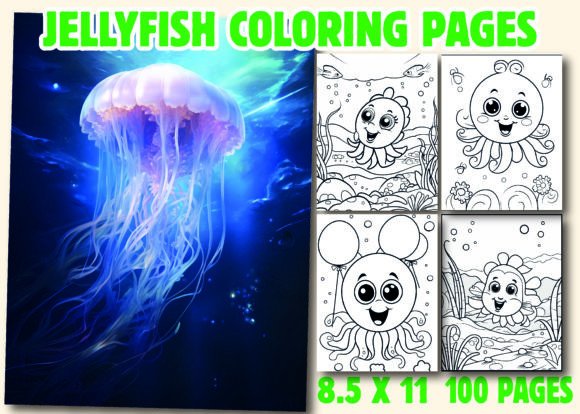
A truly functional Jellyfish Coloring Pages for Kids interior requires more than quantity—it demands consistency, scalability, and print-readiness. That means every page must be built at true 300 DPI, vector-clean (or raster-optimized), and sized precisely to 8.5″ x 11″ with proper bleed and margin allowances. It also means variety with purpose: some pages spotlight single jellyfish with bold contours; others add coral, bubbles, or friendly sea turtles—just enough context to spark storytelling, not so much that it distracts from the central subject.
This is why the included AI source file matters—not as a novelty, but as insurance. If you need to adjust line thickness, reposition a tentacle, or convert a page to grayscale for a special edition, having editable layers saves hours. Relying only on flattened PDFs or JPGs locks you out of those refinements. And while PDFs are essential for final upload, they shouldn’t be your only working format.
How File Types Shape Your Workflow—and Your Profits
Let’s talk practical file use:
- PNG files preserve transparency and sharp edges—ideal for mockups, thumbnails, or social media teasers. Use them to show off clean, isolated jellyfish art without background interference.
- JPG files load faster online and compress well—but avoid using them as your primary interior assets. Their lossy compression softens edges over time, especially after multiple saves.
- The AI source file is your safety net. Need to generate alternate versions—left-facing jellyfish, simplified versions for younger kids, or themed bundles (e.g., “Bioluminescent Jellyfish Pack”)? Editability unlocks that flexibility without redrawing from scratch.
- The final PDF should be print-optimized: CMYK-ready (if you ever expand beyond KDP), embedded fonts (none used here—clean line art needs no type), and crop marks if required. This version goes straight to KDP—no last-minute fixes needed.
Skipping this layering—relying solely on one file type—limits your ability to iterate, test, or repurpose. It also increases risk: if KDP rejects your PDF for margin issues, and you don’t have the AI file to adjust and re-export, you lose days—not just edits.
What to Verify Before You Upload—or Buy
Before listing your jellyfish coloring book on KDP, run these quick checks:
- Zoom in at 400% on three random pages. Do lines stay crisp? Do tentacles render as solid black—not grayish or broken? If not, resolution or export settings need correction.
- Open the PDF in Adobe Acrobat (not Preview or Chrome) and check the “Properties > Description” tab. Confirm it reports “300 PPI” and “8.5 x 11 in” under page size—not “A4” or “Letter (default).” Small discrepancies trigger KDP warnings.
- Print one page on your home printer using “Actual Size” (not “Fit” or “Shrink to Fit”). Hold it next to a standard sheet of paper. Does the border align cleanly? Are margins even? Uneven margins often mean improper document setup—not user error.
- Scan the first 10 pages for repetition. True variety means differences in pose, orientation, size, and surrounding elements—not just recolored versions of the same outline. Children notice sameness faster than adults assume.
If you’re purchasing a pre-made interior like this one, these checks shift from “your responsibility” to “your due diligence.” They’re not barriers—they’re filters that separate polished, tested assets from hopeful placeholders.
Realistic Expectations for Your High-Content Book Business
This Jellyfish Coloring Pages for Kids collection isn’t designed to replace your design skills—it’s built to accelerate them. The 100 unique pages give you room to curate sequences, add simple instructions (“Trace the jellyfish’s path through the ocean!”), or pair pages with short facts (“Jellyfish have no brains—but they’ve been around for over 500 million years!”). That kind of thoughtful layering turns a coloring book into a subtle learning tool—without sacrificing fun.
And because it’s been fully tested on KDP—uploaded, previewed, ordered as a physical proof, and verified across multiple devices—it removes guesswork from your launch timeline. No surprises at 2 a.m. before your deadline. Just clarity: cover images ready, interior consistent, formats aligned, and audience matched.
You don’t need more pages. You need the right pages—designed for how children color, how printers render, and how Amazon’s system validates. That’s what transforms a good idea into a reliable, repeatable, reader-approved KDP title.