Self Control Activity Book Canva KDP
What if self-regulation wasn’t just taught—but experienced, shaped, and personalized? The Self Control Activity Book Canva KDP bridges that gap. It’s not a static workbook. It’s a living, editable toolkit—designed for creators who understand that emotional awareness grows best when it’s visually engaging, contextually relevant, and deeply adaptable.
Every interior page is built in Canva and fully editable: swap fonts to match your brand voice, adjust color palettes to evoke calm or focus, resize elements for accessibility, restructure layouts for different age groups or learning styles—and yes, embed original photos, illustrations, or client-specific imagery. You’re not filling in blanks—you’re designing the experience.
A Resource Built for Real-World Use
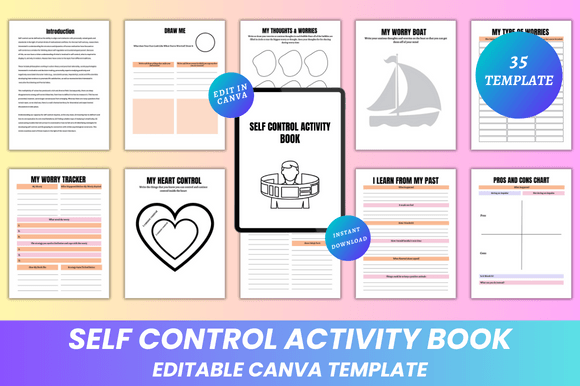
This isn’t theoretical. Educators use it to scaffold social-emotional learning (SEL) in hybrid classrooms—customizing prompts like My Worry Boat or My Anger Tracker with student names, classroom norms, or school-wide behavior frameworks. Therapists adapt My Think Sheet and Things That I Control vs. Things That I Cannot Control to align with CBT or DBT goals—adding clinical language, icons, or progress indicators that resonate with their clients’ needs.
Entrepreneurs and coaches turn Getting Ahead and I Am On Track into client onboarding tools—embedding their service pillars, milestone checklists, or accountability structures directly into the layout. Freelance designers use the editable files as a starting point for premium digital wellness kits—layering custom illustrations, branded typography, and interactive PDF features before delivering to clients or listing on marketplaces.
Creative Flexibility Without Compromise
The included 8.5 × 11 inches print-ready PDFs ensure professional output—whether printing at home, sending to a local print shop, or preparing for KDP upload. High-resolution JPG and PNG exports give you flexibility for digital previews, social media teasers, or website demos. No pixelation. No layout shifts. Just clean, consistent fidelity across formats.
But the real power lies in how you reinterpret structure. For example:
- For teens and young adults: Swap My Type Of Worries with emoji-based categories or mood sliders—then pair it with Worry Exploration as a reflective journaling sequence.
- For neurodivergent users: Simplify My Safety Tracker into visual cue cards with minimal text, using color-coded zones instead of paragraphs.
- For corporate wellness: Repurpose Pros And Cons Chart and Final Thought into decision-making templates for leadership development—overlaying company values or strategic priorities.
Because every template is editable, you decide what “self-control” means in your context—not the other way around.
Design With Intention, Not Just Decoration
Editing isn’t about making things prettier. It’s about increasing clarity, reducing cognitive load, and honoring user intent. A teacher might reduce font size in My Thoughts Worries to leave more writing space. A blogger could replace generic clipart in My Heart Control with hand-drawn heart rhythms synced to breathing exercises. An educator supporting English learners might add bilingual labels to Self-reflection and Self Esteem, then simplify sentence stems without losing depth.
Consistency matters—but so does authenticity. Keep your edits purposeful: choose one primary font family (not three), limit your palette to 3–4 emotionally resonant colors (e.g., deep blue for calm, warm amber for energy), and maintain clear visual hierarchy—headings larger than body text, trackers aligned left-to-right, reflection prompts spaced generously.
From Template to Trusted Tool
What makes this more than another printable? Its scaffolding. Pages like Belongs To, Introduction, and Final Thought aren’t filler—they create narrative continuity. They frame the activity book as a journey, not a checklist. When you customize Draw Me, you’re not just adding art—you’re inviting identity expression. When you revise Don’t Let Your Feelings Control You, you’re affirming agency, not suppressing emotion.
That intentionality transfers to your audience. Students remember the version they helped co-create. Clients engage more deeply with worksheets that reflect their real-life constraints and strengths. Readers trust resources that feel seen—not standardized.
Practical Next Steps for Creators
If you’re building for KDP: Use the editable Canva link to test variations—try a minimalist black-and-white version alongside a soft pastel theme. Upload both as separate listings and track which resonates more with your audience. Always include “editable” and “Canva” in your backend keywords—but let your description show *how* editing adds value.
If you’re adapting for digital delivery: Export individual pages as PNGs and layer them into Notion, Canva Docs, or Google Slides—with hyperlinked navigation or embedded audio prompts. Pair My Worry Time Worksheet with a 5-minute guided audio track and deliver as a micro-course.
If you’re teaching or coaching: Print select pages on cardstock, laminate key trackers (My Anger Tracker, My Safety Tracker), and use dry-erase markers for repeat use. Add blank margins to My Top 5 Worries for handwritten notes during sessions—then scan and archive securely.
You don’t need to reinvent self-regulation. You just need a foundation flexible enough to grow with your audience—and grounded enough to hold real insight. The Self Control Activity Book Canva KDP gives you both: structure that supports, and space that invites.
Ready When You Are
No waiting for permissions. No licensing hurdles. No design degree required. Just an editable Canva link, your goals, and the willingness to shape tools—not just use them. Whether you’re launching a new product line, supporting students through transition, guiding clients toward steadier choices, or simply creating something that reflects your own understanding of emotional resilience—the interior pages are yours to refine, extend, and make meaningfully yours.