Stress Management Log Book KDP Interio
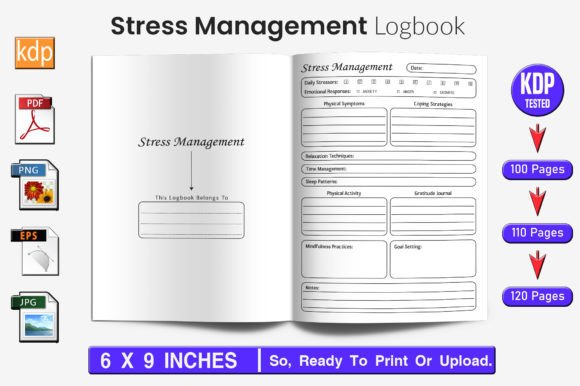
If you're building a low-content publishing business on Amazon KDP—and especially if you're aiming for speed, scalability, and consistent quality—the Stress Management Log Book KDP Interio isn’t just another interior file. It’s a tested, production-ready asset designed to reduce friction in your workflow while increasing confidence in your final upload.
This isn’t a generic template cobbled together from free vectors or resized raster images. It’s 100 pages of clean, vector-based, KDP-validated interior content—fully editable in Adobe Illustrator, scalable without pixelation, and built with real-world printing constraints in mind: 6×9 inches trim size, 300 DPI resolution, no bleed, and print-optimized layout spacing.
Why This Interior Stands Out in a Crowded Niche
Most stress journal interiors fall into one of two categories: oversimplified (thin lines, inconsistent spacing, untested margins) or over-engineered (complex layers, embedded fonts that break on KDP, or bleed-dependent designs). The Stress Management Log Book KDP Interio avoids both traps.
It ships with three page count options—100, 110, and 120 pages—giving you flexibility depending on your cover design, target audience expectations, or competitive positioning. Need a compact 100-page version for a minimalist branding strategy? Done. Prefer a slightly more substantial feel with 120 pages to justify a higher price point? Also included. No redesigning required.
The vector foundation means you’re not locked into one size or format. Resize a single page to fit a 5×8 journal or stretch it across an 8.5×11 workbook—without losing sharpness. That adaptability saves hours when A/B testing formats or expanding into complementary niches like gratitude journals or habit trackers.
Real-World Use Cases Across Roles
For freelancers and solopreneurs: You can launch a branded stress log series in under 48 hours. Swap out the title font, adjust the header color to match your brand palette, and drop in your logo using the transparent PNG bonus files. Because the EPS source is layered and labeled, even non-designers can make confident edits—no guesswork involved.
For educators and wellness coaches: This interior works as-is for classroom handouts or client workbooks—but it’s also easy to annotate. Add custom reflection prompts in the margin space, insert QR codes linking to guided breathing audio, or embed your own assessment scale at the end. The clean structure supports customization without compromising readability.
For marketers and content creators: Pair this interior with a high-converting cover (think muted earth tones + bold sans-serif title), and you’ve got a product that ranks well for “stress journal,” “anxiety log book,” and “mindfulness planner.” The KDP-tested formatting eliminates common rejection triggers—like text too close to the gutter or inconsistent line weights—so your listing stays live and your ad spend converts.
For publishers scaling a catalog: Since all 100 pages are built on a repeatable grid system, you can batch-edit headers, adjust spacing globally via Illustrator’s Find/Replace Style, or export variants (lined, dotted, blank) from the same base file. That kind of efficiency compounds fast—especially when managing dozens of low-content titles.
What “KDP Tested” Actually Means Here
“KDP tested” isn’t marketing fluff—it’s documentation of real validation. This interior has been uploaded, previewed, and approved through Amazon’s live preview tool and actual print-on-demand fulfillment. That includes checking for:
- Margin safety (no clipped headers or footers)
- Consistent grayscale rendering (no unintended shadows or gray bands)
- Font embedding compatibility (no missing glyphs or substitution warnings)
- Page count accuracy (no blank pages inserted by KDP’s auto-processing)
- File size compliance (under 500 MB, optimized for fast upload)
You won’t waste time troubleshooting why your interior looks fine in Illustrator but renders fuzzy on Kindle Previewer. Or why page 73 suddenly shifts left by 2 mm. Those issues were caught—and resolved—before you ever open the file.
Practical Tips Before You Start Editing
First, open the EPS file in Illustrator—not Photoshop or Canva. Vector fidelity depends on native support. If you’re new to Illustrator, focus edits on the top layer only (labeled “EDITABLE TEXT & ELEMENTS”). Leave the background grid and guides untouched unless you’re adjusting overall proportions.
Second, use the included high-res JPGs for quick mockups on social media or your sales page. They render faster than PDF previews and display correctly on mobile—critical when showcasing your journal on Instagram or Pinterest.
Third, test print a single page before uploading the full interior. Even with bleed-free settings, paper stock and printer calibration vary. A $2 test print saves you from ordering a full proof copy—or worse, a negative review about misaligned lines.
And finally: don’t over-customize. Many sellers assume more color = more appeal. But stress journals perform best with calm, accessible aesthetics—soft blues, warm grays, restrained typography. Let the structure do the work. The Stress Management Log Book KDP Interio already delivers clarity, rhythm, and breathing room on every page.
More Than Just Pages—It’s a Launchpad
This interior doesn’t just fill a gap. It lowers the barrier to entry for launching purpose-driven, therapeutic low-content books—without sacrificing professionalism. Whether you’re repurposing it for corporate wellness programs, bundling it with digital courses, or using it as a lead magnet for your coaching practice, the underlying design supports intentionality—not just decoration.
And because it’s built for longevity—not trend-chasing—you won’t need to replace it every season. Update the cover, refine your subtitle, or add a short intro page: the interior remains reliable, readable, and quietly effective.
If your goal is to grow your KDP business with less trial-and-error and more predictable output, the Stress Management Log Book KDP Interio earns its place in your core toolkit—not as a shortcut, but as a well-engineered foundation.